 IGNITE
 A shared vocabulary for AI use in English classrooms
The IGNITE Framework
The IGNITE Framework is a six-level model for AI use in Secondary English classrooms, Grades 7 to 12, developed by George O'Toole, a retired Ontario Head of Department with over 35 years teaching.
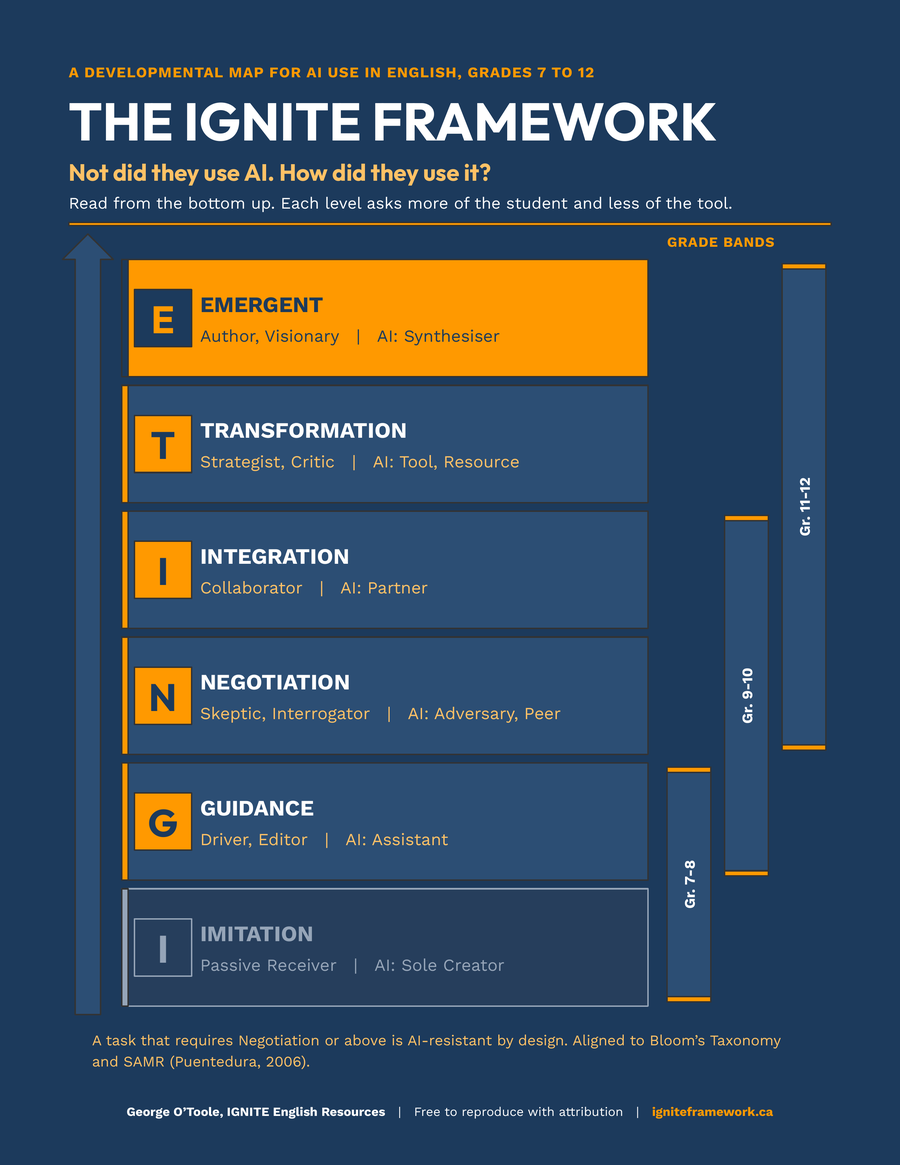
The six levels describe the relationship between a student and an AI tool, from copying an answer to producing something neither could have made alone. It sits alongside Bloom's Taxonomy and the SAMR model created by Dr. Ruben Puentedura as a working alignment: a design aid, not a one-to-one match. Bloom's describes kinds of thinking, SAMR describes what technology does to a task, and IGNITE describes how a student's thinking relates to AI, so a higher level doesn't guarantee deeper thinking.
In practice the framework does three jobs. It gives a department one shared vocabulary for AI use, the Audit diagnoses where any assignment sits on it, and the design principles below show how to move an assignment to the level you want.
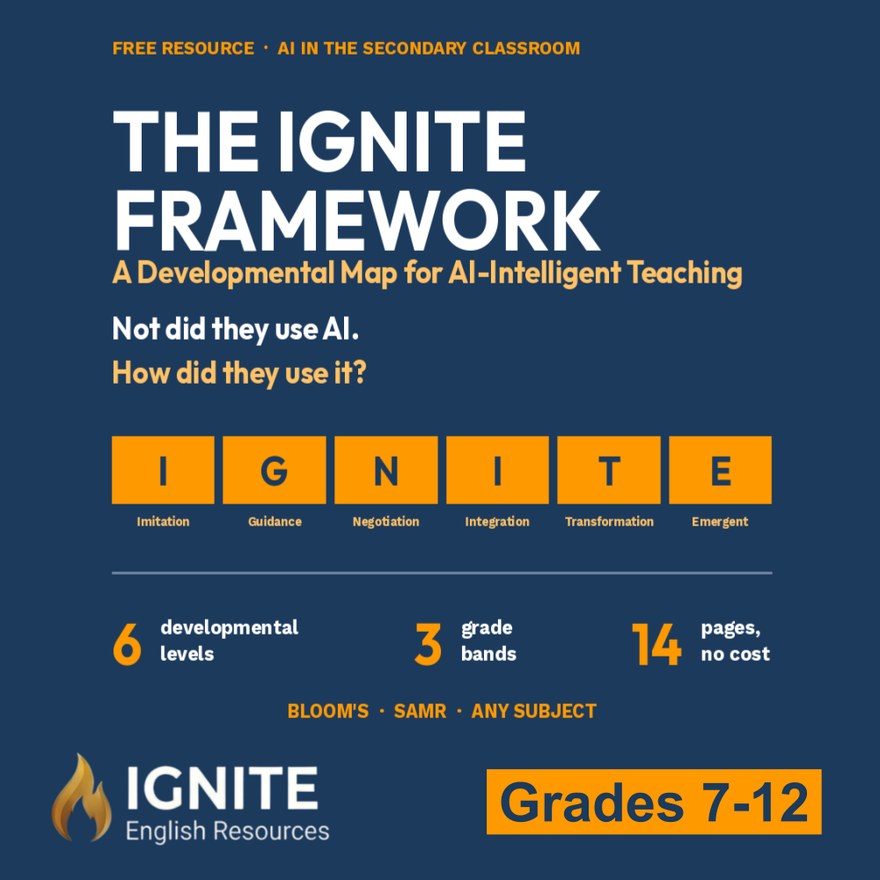
Free guide
The Full Framework in 14 Pages
Everything on this page as a free, print-ready guide: the six levels, the three grade bands, and the Bloom's and SAMR alignment, for any subject.
What Is AI-Resistant Assessment?
AI-Resistant assessment is designed so that an AI chatbot can't produce a passing submission on its own. It doesn't rely on detection software and it doesn't depend on banning anything. It works structurally, by asking for evidence a machine can't supply: process collected over time, thinking done in the room in front of you, and specificity that only a student who was present in class could produce. No design can stop a student using AI somewhere along the way. The aim is that AI alone isn't enough, because the evidence that earns the marks has to come from the student's own thinking.
There's a one-minute version. Paste your assignment instructions into an AI chatbot and ask whether you'd give what comes back full marks, or close to it. If you would, the assignment isn't yet AI-Resistant. A strong AI answer doesn't mean the task is worthless. It means the task may not be collecting enough evidence of the student's own thinking. The Assignment Audit is the thorough version, and it names the fix rather than just the problem.
What Is AI-Intelligent Assessment?
AI-Intelligent assessment is the next question after resistance. Where AI-Resistant design asks what a machine can't do, AI-Intelligent design asks what a student can do better because AI exists, and how you'd assess it. AI-Intelligent design permits AI use openly, requires students to declare and question their use of it, and marks the quality of that judgement as part of the process work.
AI-Resistant and AI-Intelligent aren't opposites and a department doesn't choose between them. Resistance protects the assessment of independent thinking. Intelligence develops the newer skill of working with a tool honestly and effectively. Most English courses need both, and The IGNITE Framework is the vocabulary that lets a department say which one a given task is doing.
AI can write a polished essay on any text. It can't reference a class discussion from last Tuesday, explain why a thesis changed between Draft 1 and Draft 2, or sit in your room and write for 15 minutes while you watch and conference.
The Six Levels
| Level | Bloom's Taxonomy | SAMR | Student role |
|---|---|---|---|
| I: Imitation | Remember, Understand | Substitution | Passive Receiver |
| G: Guidance | Understand, Apply | Augmentation | Driver, Editor |
| N: Negotiation | Apply, Analyse | Augmentation + | Skeptic, Interrogator |
| I: Integration | Analyse, Evaluate | Modification | Collaborator |
| T: Transformation | Evaluate, Create | Modification + | Strategist, Critic |
| E: Emergent | Create, highest order | Redefinition | Author, Visionary |
What Each Level Looks Like
- IImitationThe student copies AI output with little or no change. Grades 7 to 8 floor, and the most common default at every level.
- GGuidanceAI use is teacher-controlled or modelled. The student directs and edits. Grades 7 to 8 core target, Grades 9 to 10 floor.
- NNegotiationAI use is declared and interrogated. The student pushes back on what it produced. Within the Grades 9 to 10 range, Grades 11 to 12 floor.
- IIntegrationAI is a regular partner within stated limits, used to develop the student's own ideas. Grades 9 to 10 core target, within the Grades 11 to 12 range.
- TTransformationCritical questioning produces work in a form that wouldn't have existed otherwise. Grades 11 to 12 core target.
- EEmergentThe student creates something original and meaningful that neither they nor the AI could have produced alone. The top of the Grades 11 to 12 range.
The Six Levels in Practice
Knowing the names is the easy part. This is what each level asks of a student, what AI is doing, and what that means for what you collect and mark. Use it to set the level an assignment allows, and to tell students plainly what crosses the line.
I Imitation
The level to design against
- What the student does
- Copies AI output with little or no change.
- What AI does
- Sole creator: it does the thinking and the writing.
- What you collect
- A finished product, which can't tell you who did the thinking.
- What you assess
- Nothing reliable about the student's own thinking.
- Unacceptable use
- Any task marked as the student's own work that stops here.
G Guidance
Core target, Grades 7 to 8
- What the student does
- Follows AI use the teacher has set up or modelled, directs it, and edits what comes back.
- What AI does
- Assistant: it works only for the purpose the teacher sets, such as generating starting ideas.
- What you collect
- The prompts used, the student's edits, and a short note on what changed and why.
- What you assess
- The quality of the student's choices and edits.
- Unacceptable use
- Using AI beyond the purpose the teacher set, or submitting output unedited.
N Negotiation
- What the student does
- Declares AI use and pushes back: checks, questions, and rejects what it produced.
- What AI does
- Adversary or peer: it offers suggestions or feedback the student has to test.
- What you collect
- A declaration of AI use and the student's record of what they accepted, what they rejected, and why.
- What you assess
- The reasoning behind each decision to accept or reject.
- Unacceptable use
- Undeclared use, or accepting suggestions without testing them.
I Integration
Core target, Grades 9 to 10
- What the student does
- Uses AI regularly within stated limits to develop their own ideas.
- What AI does
- Partner: it helps develop the student's ideas, such as testing a thesis or raising counterarguments.
- What you collect
- Process checkpoints, writing done in class, and a declaration showing where AI fit in.
- What you assess
- Whether the ideas are demonstrably the student's, and how well AI was used within the limits.
- Unacceptable use
- AI generating the argument or the analysis itself or crossing the stated limits.
T Transformation
Core target, Grades 11 to 12
- What the student does
- Questions AI critically to produce work in a form that wouldn't otherwise exist.
- What AI does
- Tool and resource: something the student questions, critiques, and redirects.
- What you collect
- The process record, the student's critique of what AI contributed, and a spoken or written defence of their choices.
- What you assess
- The originality of the result and the quality of the student's critical judgement.
- Unacceptable use
- A final form or core idea taken from AI without examination.
E Emergent
- What the student does
- Creates something original and meaningful that neither they nor AI could have produced alone.
- What AI does
- Synthesiser: it combines and recombines material under the student's direction.
- What you collect
- The full process trail and the student's account of how the work was made.
- What you assess
- Originality, authorship, and the student's command of their own process.
- Unacceptable use
- A student who can't explain or defend how the work came to be.
Prefer it on paper? The free 14-page guide on Teachers Pay Teachers sets out all six levels. Get the guide.
Find Out Where Your Assignment Sits
The free Audit puts one task through eight questions and names the level it's actually asking for, and the first thing worth changing. Five minutes.
Confirm by clicking the link in the email that follows, and the files arrive straight after. An occasional email after that, usually every week or two. Unsubscribe in one click. A personal address works better than a board one, because school filters often block the confirmation link.
Which Levels Fit Which Grades
| Band | IGNITE range | Bloom's range | SAMR range | Key question |
|---|---|---|---|---|
| Grades 7 to 8 | Imitation through Guidance | Remember through Apply | Substitution through Augmentation | Did you produce this, or did you receive it? |
| Grades 9 to 10 | Guidance through Integration | Understand through Evaluate | Augmentation through Modification | Should I trust what AI produced here, and why? |
| Grades 11 to 12 | Negotiation through Emergent | Apply through Create | Augmentation through Redefinition | What does it mean to author something with AI's help? |
Each band shows the working range, not a ceiling on any individual student. The core target within it is Guidance at Grades 7 to 8, Integration at Grades 9 to 10, and Transformation at Grades 11 to 12, which is why the senior range runs one level beyond its target. A stretch of one level above a range is realistic in an enriched or accelerated class, so Transformation at Grades 9 to 10 is within reach where the group is ready for it.
Higher isn't automatically better. The right level is the one that fits what the task is meant to assess: a task built to test a student's independent reading of a poem may sit low on purpose, and that's a sound design choice.
The three columns are meant to be read across. The Bloom's and SAMR ranges in each row are the ranges that line up with the IGNITE levels named beside them, which is what lets you put a single row into a course outline and explain exactly where it came from.
A note on the SAMR column. Dr. Ruben Puentedura's model has four levels: Substitution, Augmentation, Modification, and Redefinition. The two marked with a plus, Augmentation + at Negotiation and Modification + at Transformation, are an IGNITE extension rather than part of SAMR itself. They mark the point where a level does everything the SAMR stage describes and adds declared, interrogated AI use on top. Say so if you present this to colleagues who know the model, and it will be read as precision rather than as an error.
The Four Pillars
Every level of the framework rests on the same four commitments. If an assignment is failing, it's almost always failing on one of these, and usually on the first two.
- 1Process Over ProductAssessment of how students think and work, not only what they hand in.
- 2In-Class CognitionThe thinking that matters happens in the room, in front of you, under conditions the task sets. A conference, a scribed or recorded response, or writing done over several sittings with extended time counts just as much as timed writing. More on accommodations.
- 3AI as a Tool, not a GhostwriterWhere AI is allowed, students use it openly, name how they used it, and own what they produced. Whether to allow it stays your decision.
- 4Meta-LiteracyStudents build awareness of their own thinking and of how AI shapes the text they read and write.
Accommodations, Absence, and Multilingual Learners
A framework resting on in-class cognition has an obvious question waiting for it in any department meeting, and it's worth answering before someone asks. What happens to the student with an Individual Education Plan, the student who was away for three weeks, and the student who is still building English?
The full answer, for an IEP, an absence, or a student still building English
The pillar is evidence produced where you can see it. It isn't evidence produced under time pressure, and the two get confused because timed writing is the most familiar way of doing it. A conference where you ask three questions and make notes is in-class cognition. A scribed response, or one recorded as audio, is in-class cognition. Writing done in class across three shorter sittings with extended time is in-class cognition. What doesn't bend is that you saw the thinking happen. It's one pillar of four, though: thinking done at home still counts, through process evidence. Timed writing is one delivery of that principle and it suits the fewest students, so you may prefer to treat it as one option among several rather than as the default.
For a student who is often absent, the process weighting is the part that flexes. A missed checkpoint can be offered on return or covered in a 10-minute conference that reaches the same evidence, because the point of the checkpoint was never the artefact.
For a multilingual learner, AI used as language support is a legitimate use at the Guidance level, and the framework already has the language for it: permitted, declared, and the student owns what they produced. Naming it as Guidance is more useful than treating it as something to be quietly overlooked.
The same care applies to declarations. For some students, an approved AI tool is an access support, so ask students what they did with it and what they kept, not why they used it. No student should have to disclose a personal need to complete a declaration, and a short conversation counts just as much as a written one. There's more on this in What Critical AI Literacy Looks Like in Classrooms.
None of this changes what a student is expected to demonstrate. In Ontario, changing how a student demonstrates learning is generally an accommodation, and changing what they're expected to demonstrate is a modification. The examples above are meant as accommodations. They work that way when they keep the curriculum expectation being assessed intact and fit the student's documented supports. Where a student has an IEP, the IEP decides.
Where This Sits in Ontario Assessment Policy
Nothing in the framework asks you to work around Growing Success. In-class cognition is the one with the clearest policy backing behind it.
Growing Success asks that assessment strategies be
triangulated to include observation, student-teacher conversations, and
student products
. That's what the second pillar does. Collecting only a
take-home product uses one of those three, and it happens to be the one an AI chatbot can now supply. Adding an in-class write, a conference, or an oral defence isn't a workaround invented for AI. It's the other two thirds of the
evidence you were meant to be gathering anyway.
What the 2026-2027 Evaluation Policy Changed
The ministry replaced evaluation for Grades 9 to 12. From the 2026-2027 school year a Secondary School mark is built from three fixed parts rather than from whatever a department agreed among itself. At Grades 9 and 10 that's 65 percent classroom work, 20 percent final evaluation, and 15 percent attendance and participation. At Grades 11 and 12 it's 65, 25, and 10.
For English, the whole of that final evaluation is a written exam, written in person during a designated exam period. English sits with math and science as the only subjects carrying no culminating task component at all, so 20 percent of a Grade 9 or 10 mark, and 25 percent at Grades 11 and 12, now rests on one invigilated paper. Locally developed courses at Grades 9 and 10, and workplace and open courses at Grades 11 and 12, are exempt.
Read one way that's a constraint on your professional judgement. Read another way, the ministry has just made in-class cognition mandatory for a fifth to a quarter of every English mark in the province. An invigilated written paper is the single piece of evidence an AI chatbot can't supply on a student's behalf, and it's now required rather than optional. The argument this framework has been making since 2023 is the argument the policy now makes for you. What belongs on that paper is the question that follows, and there's a full piece on it here.
Ontario's teacher federations have reached the same conclusion from another direction. The Ontario Teachers' Federation's January 2026 discussion paper on generative AI warns that these tools can do the problem-solving, reading, and argument students are meant to be building, and it describes strong assessment as triangulating student work with observations of students at work and conversations with them. That's Process Over Product and In-Class Cognition by another name. The OSSTF/FEESO member advisory adds a rule worth building into any AI activity: nothing that identifies a student, including assessment data, goes into an AI tool. There's a closer look at both documents in a separate piece.
The conclusion isn't only Ontario's, or only about Secondary school. In August 2026, MIT's committee on AI in teaching and learning recommended oral exams, portfolios, and out-of-class work paired with in-class conversations and warned against simply moving everything into timed exams. That's the balance behind the 40-40-20 model below. There's a translation of that report for a Secondary English class in a separate piece.
One thing follows for everything below. In an Ontario Grade 9 to 12 English course, every assessment the framework describes lives inside that 65 percent. The weighting in the next section is a model for the work in that portion, not a plan for a whole course mark. It's still the largest of the three parts by some distance, and it's the part where the thinking actually gets built.
The rubrics in every IGNITE resource use the Ontario four-level scale, Limited, Some, Considerable, and High effectiveness, rather than letter grades or percentages, and the process work is assessed rather than only collected.
Teaching Outside Ontario
The framework was developed in Ontario, and this section is about Ontario policy. The six levels, the four pillars, and the 40-40-20 model don't depend on Growing Success, though, so if you teach elsewhere in Canada, in the United States, or overseas, adapt them to your own achievement scale, reporting rules, and school policies.
One Practical Assessment Model 40-40-20
The framework describes the levels. It doesn't dictate a mark breakdown. What follows is the weighting I use, offered as a working model rather than a rule, and every IGNITE resource is built on it. The principle underneath is the part that matters: distribute the marks so that no single take-home product, the one thing AI is most able to produce, dominates the grade. In an Ontario Grade 9 to 12 English course these three parts divide the classroom work, which is the 65 percent described above, rather than the whole course mark.
| Component | Weight | Why it holds |
|---|---|---|
| Process work: brainstorming, drafts, checkpoints | 40% | Retrieval practice across several sessions, and a visible trail |
| In-class cognition: oral, timed writing, cold read | 40% | Live thinking you can observe, under conditions the task sets |
| Final product: essay, presentation, submission | 20% | Still valued, no longer the sole measure |
This doesn't penalise a student who uses AI responsibly. It rewards the student who did the thinking at all three stages. Adjust the split to suit your course if you wish. A department that moves to 30-40-30 and applies it consistently has still made the change that counts.
What the IGNITE Framework Is Not
Four things it makes no claim to be, because a framework that oversells itself is no use to you in a department meeting.
- 1It's not a detection toolIt won't tell you whether a particular student used AI, and nothing on this site will. It changes what you collect as evidence, so that the question comes up less often and can be settled by a conversation rather than by a percentage.
- 2It's not a banBlocking the tools moves the use out of sight rather than out of the course. The levels describe a classroom where AI is prohibited just as accurately as one where it's permitted.
- 3It's not the first work in this spaceThe AI Assessment Scale, developed by Dr. Mike Perkins, Dr. Leon Furze, and colleagues, is the established prior work and it does its job well across subjects and sectors. The IGNITE Framework is deliberately narrower: Secondary English, Grades 7 to 12, Ontario aligned, and it arrives with the classroom materials attached.
- 4It's not a promise of an AI-proof assignmentNo assignment is AI-proof, and the models improve every few months. What a well-designed task does is make the shortcut more work than the work and keep enough of the evidence in the room that a shortcut shows.
Why Trust This Framework
A framework is only worth using if you can check it. Here's what this one rests on, and where to test it for yourself.
- 1It comes from the classroomIt was built by a Secondary English Head of Department with over 35 years in the subject, who still teaches, and every resource built on it was written for real classes.
- 2Independent guidance reaches the same conclusionsOntario's teacher federations and MIT's committee on AI in teaching and learning arrived separately at process evidence, in-class thinking, and clear reasons for each AI rule. Neither endorses IGNITE; read the federation documents and the MIT report and judge for yourself.
- 3It states its limitsIt isn't a detection tool, a ban, or a promise of an AI-proof assignment, and it acknowledges earlier work such as the AI Assessment Scale. The section above says so plainly.
- 4It's open about how it's madeThe resources are built with AI as a partner, and exactly how is set out in full.
- 5You can test it for freeRun one of your own assignments through the Audit. If the result doesn't tell you something useful, the framework hasn't earned your trust yet.
Questions Teachers Ask
Is the IGNITE Framework a ladder students climb once?
No. Imitation isn't a stage students pass through and leave behind. It's the most common default at every grade level whenever AI is available and oversight is low, so it stays a live risk in Grade 12 as much as in Grade 7. The framework describes where a particular task sits, not where a student permanently lives.
How is this different from SAMR or Bloom's Taxonomy?
It's not a replacement for either. SAMR describes what the technology is doing to the task and Bloom's describes the thinking demanded. Neither was written with a machine that can produce the finished product in mind. The IGNITE Framework is current, and it creates a shared vocabulary for the relationship between the student and the AI. It maps onto both of the others, so a department can hold one holistic conversation instead of three separate ones.
Do I have to allow AI use to teach with this framework?
No. The IGNITE Framework describes what's happening whether you permit it or not. The levels describe a classroom where AI use is blocked as accurately as one where it's allowed. This framework helps most in naming, out loud and in the same words as your colleagues, what level a given assignment is asking for.
What grade range is it for?
Intermediate and Senior. Grades 7 to 12. The band targets differ. The core target is Guidance at Grades 7 to 8, Integration at Grades 9 to 10, and Transformation at Grades 11 to 12. A stretch of one level above a band is realistic in an enriched or accelerated class, but not in a general course.
Can I use the framework outside English?
Teachers have reported using it in other subjects for assignment design and for conversations about ethical AI use. The IGNITE Framework was built specifically for Secondary English and the examples are literary, so expect to modify the task-level details if you're using it cross-curricularly.
Finished reading?
Take the Full Guide with You
The whole framework in 14 pages, free on Teachers Pay Teachers. Share it with your department or keep it beside your planning.
Start with One Assignment
Take an ordinary assignment, not your best one and not the one that worries you most and put it through the Audit. Five minutes, free, and the result names the one thing worth changing first.
Audit an AssignmentWhy Detectors Are the Wrong ToolDeveloped by George O'Toole: Over 35 years in Secondary English, Head of Department, Educational Technology Coach, Faculty of Education instructor. Meet George