
How to Run the Assignment Audit and Redesign One Assignment
Start here
The test that starts the Audit, what AI can and can't do in your classroom, and the five steps that turn an assignment an AI chatbot can pass into one it can't.

George O'Toole, retired Head of Department
Free for Grades 7 to 12 English teachers
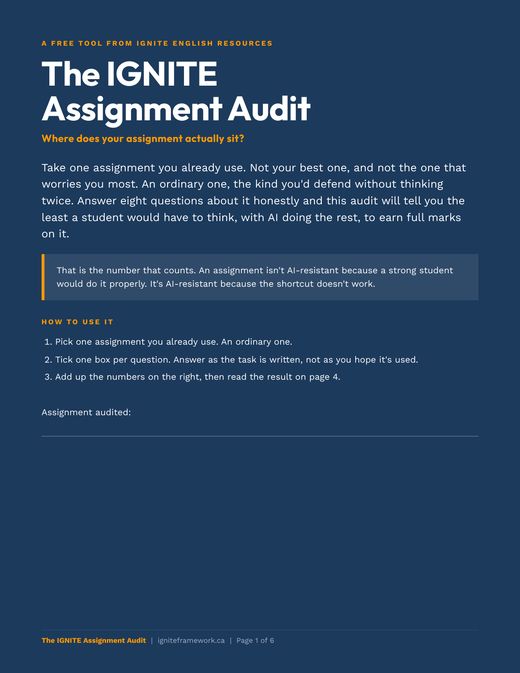
Pick one assignment you already use and answer eight questions about it. The Audit tells you how much of it an AI chatbot could do for your students, and the one thing worth changing first.
Four files, for free: the interactive Audit that scores your assignment for you, the same eight questions to print and write on, and the framework poster in PowerPoint and as a vector file.
Confirm by clicking the link in the email that follows, and the files arrive straight after. An occasional email after that, usually every week or two. Unsubscribe in one click. A personal address works better than a board or district one, because school filters often block the confirmation link.
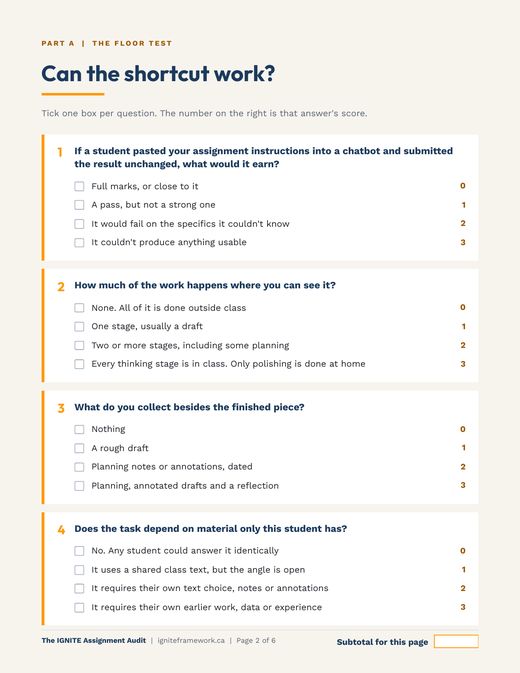
So you know what you're getting, this is question one, exactly as it appears in the Audit.
Part A, the floor test, Question 1 of 8
If a student pasted your assignment instructions into an AI chatbot and submitted the result unchanged, what would it earn?
Seven more questions like this, then a total score out of 24 that names the IGNITE level your assignment is actually asking for. The interactive version scores it for you automatically and puts your weakest answers in the order worth fixing.
See it before you sign up
A sample run through all eight questions, about 25 seconds from the first answer to the result, which names the one thing to fix first.
The interactive Audit is one of the four free files you get when you sign up.
This is a typical Grade 10 essay task, the kind that has been given for 30 years and was perfectly fine until about 2023.
Before
"Write a 1000-word essay explaining how Shakespeare presents the theme of fate in Romeo and Juliet. Due in two weeks."
The one-minute test
Paste those instructions into any AI chatbot. What comes back in mere seconds is a competent essay, with quotations that look right whether or not they are. Nothing in the task asks for anything an AI chatbot can't produce, so nothing in the task stops one.
After
The essay question doesn't change. What you collect does.
An AI chatbot can still write about fate. But it can't stand in for the annotations you collected in class on Tuesday, the 20 minutes you watched a student work, or a student explaining and defending their own choices out loud. The difference is the evidence you collect, not how polished the essay is. One possible weighting for this task: 40% process, 40% in-class thinking, and 20% final product.
That redesign took one page. The Audit does the diagnosis part for you, on your assignment, in five minutes. The method behind it is set out in the five-step redesign.
Every assignment asks for one of these, whether it means to or not. Each level asks more of the student and less of the tool. Higher isn't automatically better: the right level is the one that fits what the task is meant to assess.
Copies AI output with little or no change.
The level to design against
Follows AI use the teacher has set up or modelled, directs it, and edits what comes back.
Core target, Grades 7 to 8
Declares AI use and pushes back: checks, questions, and rejects what it produced.
The threshold for AI-resistant work
Uses AI regularly within stated limits to develop their own ideas.
Core target, Grades 9 to 10
Questions AI critically to produce work in a form that wouldn't otherwise exist.
Core target, Grades 11 to 12
Creates something original and meaningful that neither they nor AI could have produced alone.
Top of the Grades 11 to 12 range
Practical pieces for English departments working out what assessment looks like now.
Start here
The test that starts the Audit, what AI can and can't do in your classroom, and the five steps that turn an assignment an AI chatbot can pass into one it can't.
Understand the problem
Why detection software is the wrong basis for an integrity decision, and the three kinds of evidence that work instead.
The bigger question
Why "Did you use AI?" is becoming the wrong question, and three classroom moves that let you see the thinking while it happens.

The IGNITE Framework was developed by George O'Toole, a retired Ontario Secondary School English Head of Department with over 35 years in the subject. He still takes supply work, so the classroom isn't a memory, it's his reality.
"Flexible enough to use with other disciplines, and useful for assignment design and conversations about ethical AI use."
Stephen H., Grade 11 teacher, on the IGNITE Framework
35+
years in secondary English
8
secondary schools coached
9
system-wide PD workshops delivered
3
Additional Qualification courses taught at Queen's
Confirm by clicking the link in the email that follows, and the files arrive straight after. An occasional email after that, usually every week or two. Unsubscribe in one click. A personal address works better than a board or district one, because school filters often block the confirmation link.